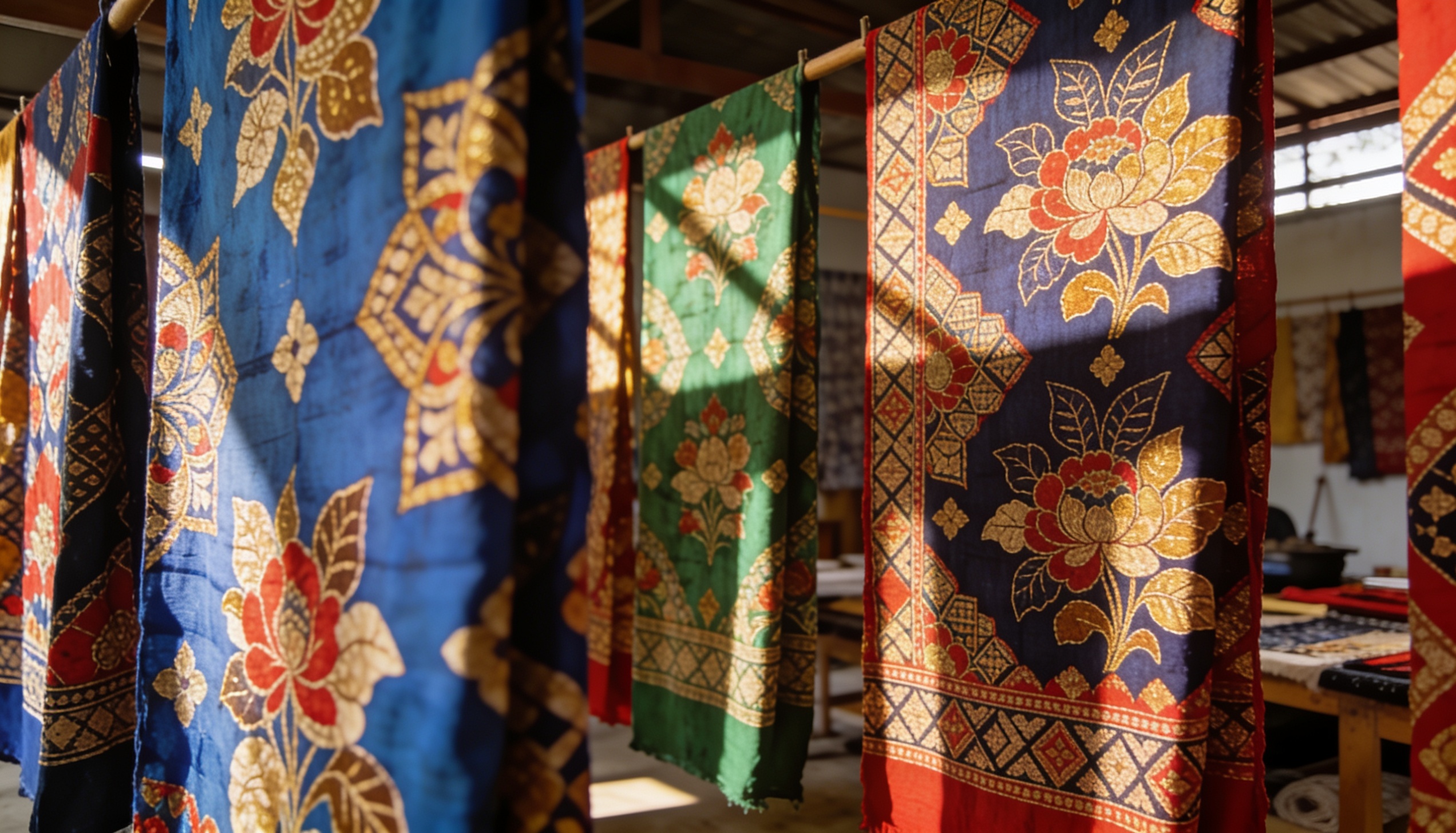
Walk past a batik workshop in Kelantan and the first thing you notice is the smell of warm wax, then the colour. Lengths of cloth hang drying in greens, blues and deep reds, every one of them patterned by hand. Batik is made across the Malay world, but Kelantan gives it a particular hand: bold, generous with colour, and full of leaves, vines and flowers. It is one of the crafts that has kept the state’s makers busy for generations, and it is still very much alive.
How the pattern is made
Batik is a resist craft, which means the pattern is built from where the dye cannot reach. The artisan applies hot wax to the cloth, the cloth is dyed, and wherever the wax sits the colour is held back. Do this again and again, adding wax and dipping in new colour, and a layered design slowly appears. The wax is finally boiled away to reveal the finished cloth. It is patient, methodical work, and the order of the dyes is part of the artistry.
Block and pen
There are two main ways to lay the wax. The first uses a copper block, a stamp called a the copper stamp used to print wax patterns , pressed into wax and then onto the cloth to repeat a motif cleanly across a length. The second uses a wax pen, the a small spouted tool for drawing wax by hand , for free, flowing lines drawn directly by hand. Block batik is crisp and rhythmic; hand-drawn batik is looser and more personal. Many of the finest pieces use both.
Every colour you see was planned in reverse, decided by where the wax was laid before the cloth ever met the dye.
A Kelantanese hand
Kelantan batik tends to be bolder than the softer, more formal styles of the west coast. The colours are confident and the motifs lean into nature: sprays of leaves, climbing vines, hibiscus and other blooms spread across the cloth. It is batik made to be worn and enjoyed, not kept quiet. You will see it on shirts and sarongs across the state, and in the markets of Kota Bharu.
Halal verifiedSee it for yourself
The best way to understand batik is to watch it being made. Workshops around Kota Bharu welcome visitors, and the living crafts of Kelantan overview is a good first read. When you are ready to take some home, there is a guide to where to buy batik in Kelantan, and the stalls of Pasar Siti Khadijah are a fine place to browse.
Why it matters
Batik could easily have become a printed imitation, churned out far from the people who once made it by hand. In Kelantan the real thing survives, wax pot and copper block and all, in workshops you can visit and from makers you can meet. That is worth celebrating. Alongside songket, batik is proof that Kelantan’s craft heritage is not a memory but a working trade.