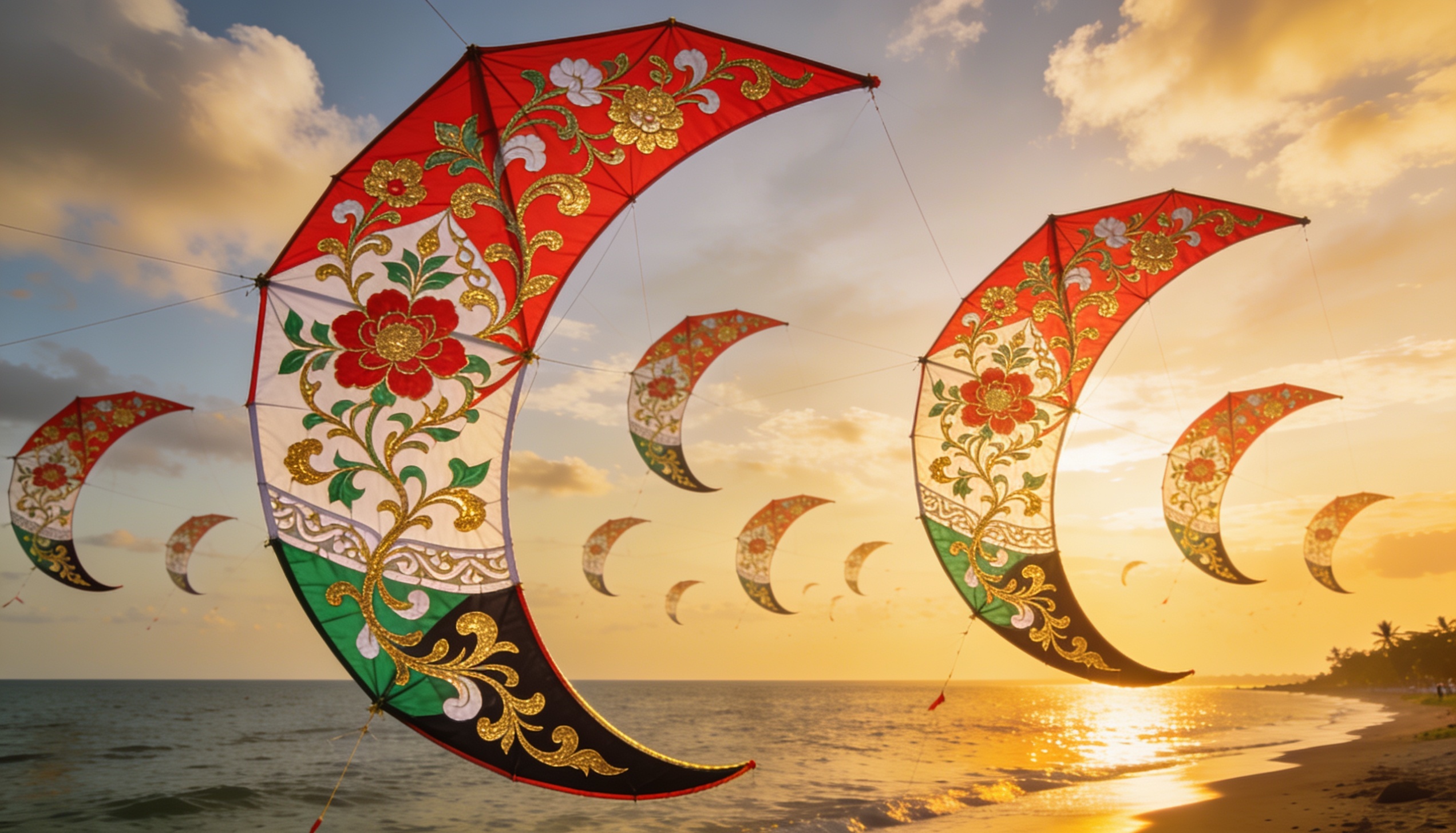
On a breezy afternoon in the Kelantan countryside, you might still see them: large, bright shapes hanging almost motionless against the sky. These are wau, the traditional kites of the east coast, and the most beloved of them is the wau bulan. It is one of the simplest pleasures Kelantan has given the country, and one of its proudest exports.
What “moon kite” actually means
The name moon kite describes its shape, not its picture. A wau bulan is a kite whose lower section curves into a broad crescent, like a new moon resting on its back — and that crescent silhouette is what gives it the name. It does not carry a painting of the moon, and there is no moon inside it. The “moon” is the form itself.
What fills the kite instead is decoration: intricate floral and leaf patterns, cut by hand from coloured paper and layered onto the body. The best wau are covered in these cut-out motifs, fine as lacework, so that even on the ground a finished kite looks less like a toy than a piece of craft.
How it is made
A wau bulan begins with a frame of split bamboo, bent and tied into the crescent and the broad upper wing. Over this the maker stretches paper, then builds up the surface with the cut-out patterns — a slow, exacting job done with a small blade.
It is made the way it has always been made: with bamboo, paper, glue, a knife, and patience.
A traditional wau bulan is also large, often taller than the person flying it, which is part of why it flies so steadily and looks so commanding overhead. Some are fitted with a bow that hums in the wind as the kite climbs, so the wau sings as well as flies.
How it is flown
Flying a big wau is not a solo scramble. It usually takes two: one to hold and release the kite, one to manage the line. Once it catches a steady wind it settles high and calm, and the skill is less in launching it than in reading the air and keeping it poised. In the open ground near the coast — places such as Pantai Cahaya Bulan — the wind off the sea is ideal, and you may still come across flyers on a good afternoon.
From the field to the nation
The wau bulan did not stay a village pastime. Its clean crescent shape and lacework patterns made it a natural emblem, and Malaysia took it to heart. The wau appears on the fifty-ringgit note, and a stylised wau has long been the symbol on the tail of the national airline. Few crafts make that journey — from a maker’s workshop to the things a whole country carries in its pocket and sees in its sky.
That is the quiet achievement here. To see where the wau sits among Kelantan’s other handmade traditions, read Kelantan, the cradle of Malay culture or browse the wider history of Kelantan. And to find the makers and markets, start with our overview of Kelantan’s living crafts.