
Kota Bharu wears its history lightly, but it runs deep. The name means something close to “new fort” or “new town”, and the town as we know it began in 1844, when Sultan Muhammad II made it the royal capital of Kelantan and raised the great audience hall, the Istana Balai Besar, beside the river. The land itself is far older, woven into centuries of trade and the early Malay kingdoms of the peninsula’s northeast, but it is around that nineteenth-century royal quarter that the modern town grew.
A capital between two powers
For much of the nineteenth and early twentieth centuries, Kelantan sat within the Siamese sphere, and the state kept a distinct character on the edge of the Thai and Malay worlds. That changed in 1909, when an Anglo-Siamese treaty brought Kelantan under British influence. The shift was felt in town, from administration to the buildings that went up, yet Kelantan held tightly to its own customs, language and faith, the thread that still defines it today.
This is also the Kelantan of Tok Janggut, whose 1915 stand against new colonial taxes became one of the best-known episodes of local resistance, remembered in the town’s museums and its collective memory.
The morning the war arrived
Kota Bharu holds a startling place in world history. On a December night in 1941, the beaches just northeast of town, around Pantai Sabak, saw the first Japanese amphibious landing in Malaya, the opening move of the Malayan campaign and, by the clock, one of the very first actions of the Pacific War. The old Bank Kerapu building, dating to around 1912, now serves as a war museum that tells this story. It is a sobering counterpoint to the gentleness of the present-day town.
A town that chose to remember
After independence in 1957, many Malaysian towns rushed to modernise. Kota Bharu grew too, but it also chose, more than most, to hold on to what made it itself: the handed-down crafts of songket and batik, the wayang kulit and the wau, the rhythm of the markets, the call to prayer over the rooftops. That decision is why a visitor today can still watch a loom at work or eat the same dishes the makcik have cooked for generations. Kelantan’s capital became known as a guardian of Malay-Islamic culture, and that identity is the through-line from 1844 to now.
A walk through then and now
History is easiest to feel when you can see it. Drag the slider on each pair below to wipe between the old town and the town today, the same places, generations apart.
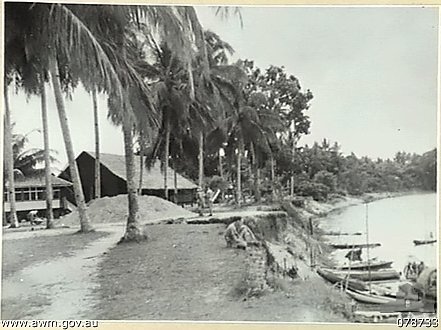 Australian War Memorial · public domain
 These landmarks are still here, still in use, and still within a short stroll of one another. The best way to understand Kota Bharu is simply to walk it, reading the old town in the buildings that remain.
See it for yourself
If the history has caught you, build it into your trip. Start with our first-timer’s guide for orientation, see the must-visit places for the heritage cluster around Padang Merdeka, and read up on local culture and etiquette so you move through these places as a welcome guest. Then take the old-town heritage walk and let the centuries unfold at walking pace.
Good to know
When was Kota Bharu founded?
Kota Bharu became Kelantan's royal capital in 1844 under Sultan Muhammad II, who built the Istana Balai Besar. The name means roughly 'new fort' or 'new town'.
Why is Kota Bharu important in World War II history?
Kota Bharu was the site of the first Japanese amphibious landing in Malaya, on the beaches just northeast of town in December 1941, which opened the Malayan campaign. The Bank Kerapu building now houses a war museum telling that story.
Is Kota Bharu a good place for history lovers?
Very much so. A compact cluster around Padang Merdeka holds the old royal palaces (now museums), the war museum and other heritage halls, all walkable in a morning.